


Nick Ustaran-Anderegg
&
October 15, 2026
Today, NVIDIA releases their latest, flagship model: Nemotron 3.5 Super VL. As part of our post-training partnership with NVIDIA, AgileRL was given early access to the model, and it is now available in Arena. You can immediately start training and deploying Nemotron 3.5 Super VL as a specialized agent for your task.
Ahead of the release, we trained Nemotron 3.5 Super VL to complete real-world, agentic computer-use tasks. Our agent learned to use an online shop and classifieds site, and navigate Reddit and Wikipedia, in a real browser, to perform everyday tasks requested by a user. They require understanding the content of screenshots, calling tools, and executing long-term plans to achieve goals.
Our results show that Nemotron 3.5 Super VL, trained with Arena, outperforms Claude Sonnet 5.5 and Opus 5.5 on a variety of browser-use tasks. Following Arena's post-training, our agent also beats the human baseline, proving its ability to automate real-world functions. Crucially, as a generalizable approach tested on unfamiliar tasks, this demonstrates that fine-tuning open-weight models offers a superior alternative to relying on proprietary APIs for specific use cases.
Arena is the platform for creating AI agents specialized at your task. Most teams arrive with a dataset or an RL environment, and Arena validates what you have before you spend anything on compute. Starting with neither is also fine; our team will build both with you from a description of the job. Training runs on an async-RL engine, optionally on your own compute, and the weights never leave it. When a run finishes, deploy in one click onto your own infrastructure and keep training on live feedback.
Nemotron 3.5 Super VL is a 120B parameter vision-language model, so it requires serious distribution and optimized training. Arena automatically applies the optimal parallelization for a training job and resources available to maximize performance. In this case, that required a combination of expert-, tensor-, data- and context-parallelism. The async-RL engine generates rollouts at the same time as learning so that GPUs are never idle, and the learner never needs to wait for fresh experiences. Compute-heavy, dockerized environments are also natively handled by Arena, which automatically spins up parallel sandboxes on your cluster, handles port routing and sessions, and scales rollouts seamlessly. Zero extra infrastructure code required.
NVIDIA released Nemotron 3.5 Super VL (nvidia/NVIDIA-Nemotron-3.5-Super-VL-120B-A12B-BF16) as a 120B vision-language model, 12B active per token, in BF16, for post-training: SFT, RL, distillation, or a quantized build you serve yourself. The language backbone interleaves Mamba-2 and MoE layers, puts attention in selected places, and takes image and video frames through a C-RADIO v4-H encoder. Prompts can run to 1 million tokens. NVIDIA licenses it under the NVIDIA Software and Model Evaluation License. Read more in NVIDIA's announcement.
Open weights and a strong multimodal pretrain make Nemotron 3.5 Super VL a top candidate for a specialized agent trained on internal data. Training and hosting your own model also comes with the benefits of greater control and security; internal data and tool access does not need to be shared with closed APIs. By training on your actual task, which frontier models have never seen, you can also exceed their performance with a much smaller model. Furthermore, inference is cheaper when hosting your own model, since you only need to pay for the compute to host it, and aren't charged by the token.
We trained and evaluated Nemotron 3.5 Super VL on VisualWebArena, a public benchmark of web tasks that need vision (Koh et al., 2024). The agent uses a real browser to navigate real websites hosted in the environment. Shopping is a full online store: catalog, reviews, cart, wishlist, checkout. Classifieds is a listings site with photos, categories, a way to contact the seller, and comments. Reddit is a Reddit-style forum with subreddits, image posts, comments, votes, subscriptions and direct messages. Wikipedia is an offline copy of English Wikipedia. Some tasks span two sites in separate tabs, for example looking something up on Wikipedia to answer a question about a Reddit post.
A task lasts up to 15 turns. Each turn the agent can see the browser's content, and can take actions on the site by calling tools and outputting text: click, fill a field, select an option, press a key, scroll, go back, open a URL, switch tabs, or send a message to the user. Some instructions also come with a photo of their own ("find this product"). The agent analyzes the task, uses reasoning to make a plan and adjust its course at each step, and acts.
VisualWebArena's published checkers look at the website after the episode and determine if the task has been completed. Possible successful end states include: the final answer has to match, the browser has to be at the right URL, the shopping cart must contain the items, a comment has to be posted. Nemotron 3.5 Super VL may use thousands of reasoning tokens over an episode, but all the learning signal comes from 'was the task successfully completed', and through trial and error the agent figures out how to get there.
Many VWA tasks require understanding photographs. These are some example tasks, held-out from training, that were used to evaluate the agent:
We trained with CISPO, the same reinforcement learning GRPO-family algorithm we used for the Nemotron Lightning runs in August. For each task the model tries eight times. Attempts that succeed are reinforced relative to the ones that fail, and a small KL penalty keeps the policy close to the original Nemotron 3.5 Super VL weights. We trained LoRA adapters of rank 8 on the attention layers, the MLPs and the mixture-of-experts layers, and left the vision encoder frozen.
Each training step draws 48 tasks and runs eight attempts on each of them, 384 browser episodes in parallel. We ran 250 learn steps, about 125,000 episodes in total, on 24 NVIDIA H100 80GB GPUs across three nodes. Sixteen GPUs were used for training with parallelism and sharding. The other eight GPUs ran two vLLM engines that generated the rollouts in FP8. After each step we copied the LoRA adapter to those engines and left the base weights in place. The run took 22 hours, about 5.2 minutes per step. Token throughput was over 2000 tokens per second for the run. This training is all coordinated automatically by Arena's Async-RL engine, which automatically configures the optimal distribution setup for each training run.
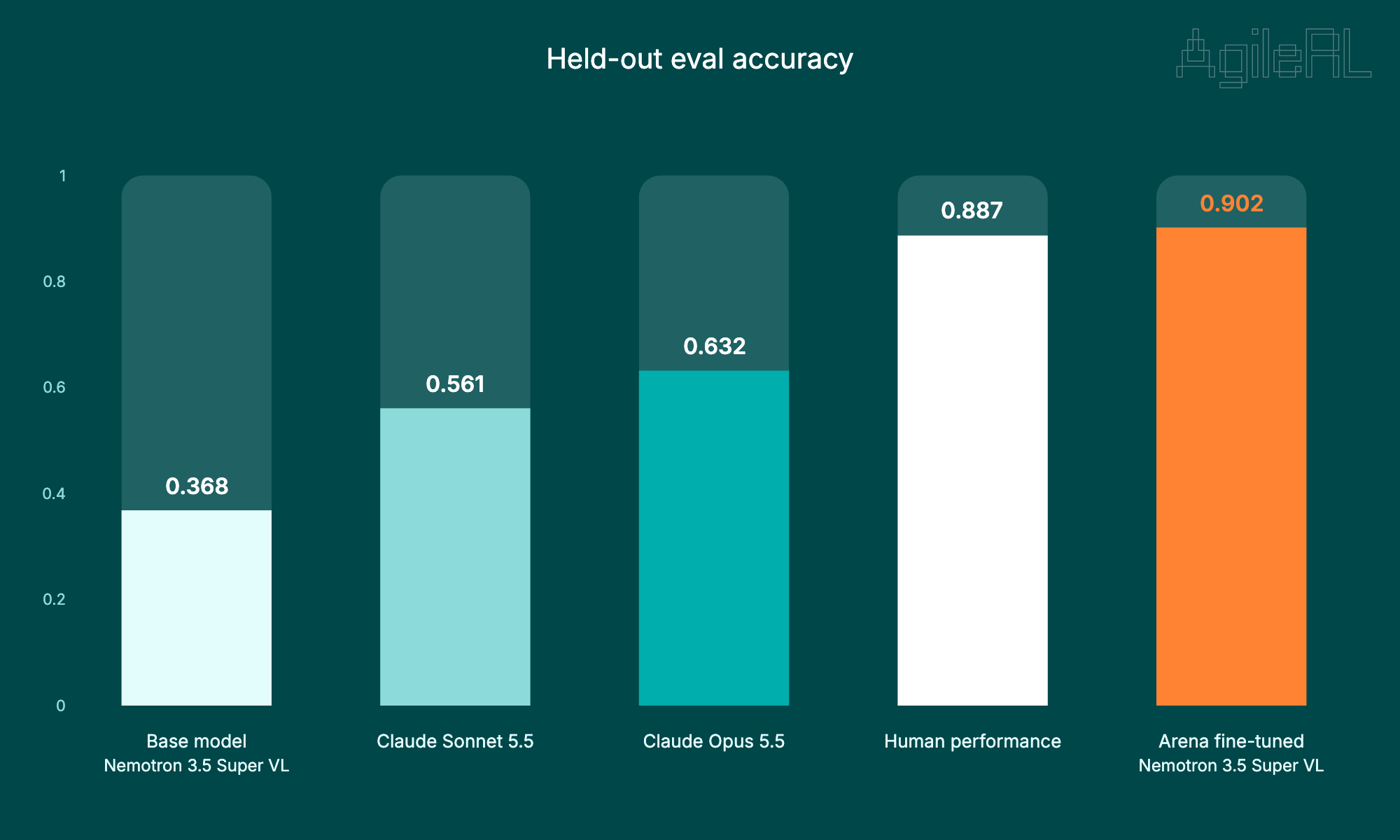
We scored Nemotron 3.5 Super VL with no extra training, Claude Sonnet 5.5 and Opus 5.5, and Nemotron 3.5 Super VL after this Arena run on 114 held-out eval tasks, using VisualWebArena's checkers.
We evaluate the training performance on three metrics. Training score is the proportion of practice episodes completed at each step. Evaluation score is success on the 114 never-seen tasks, evaluated every ten steps during training. Token throughput is tokens generated, and learned from, per second. We watch throughput because each screenshot is expensive to process; if generation is slow, each step takes longer, the GPU bill rises, and we get fewer experiments from the same cluster.
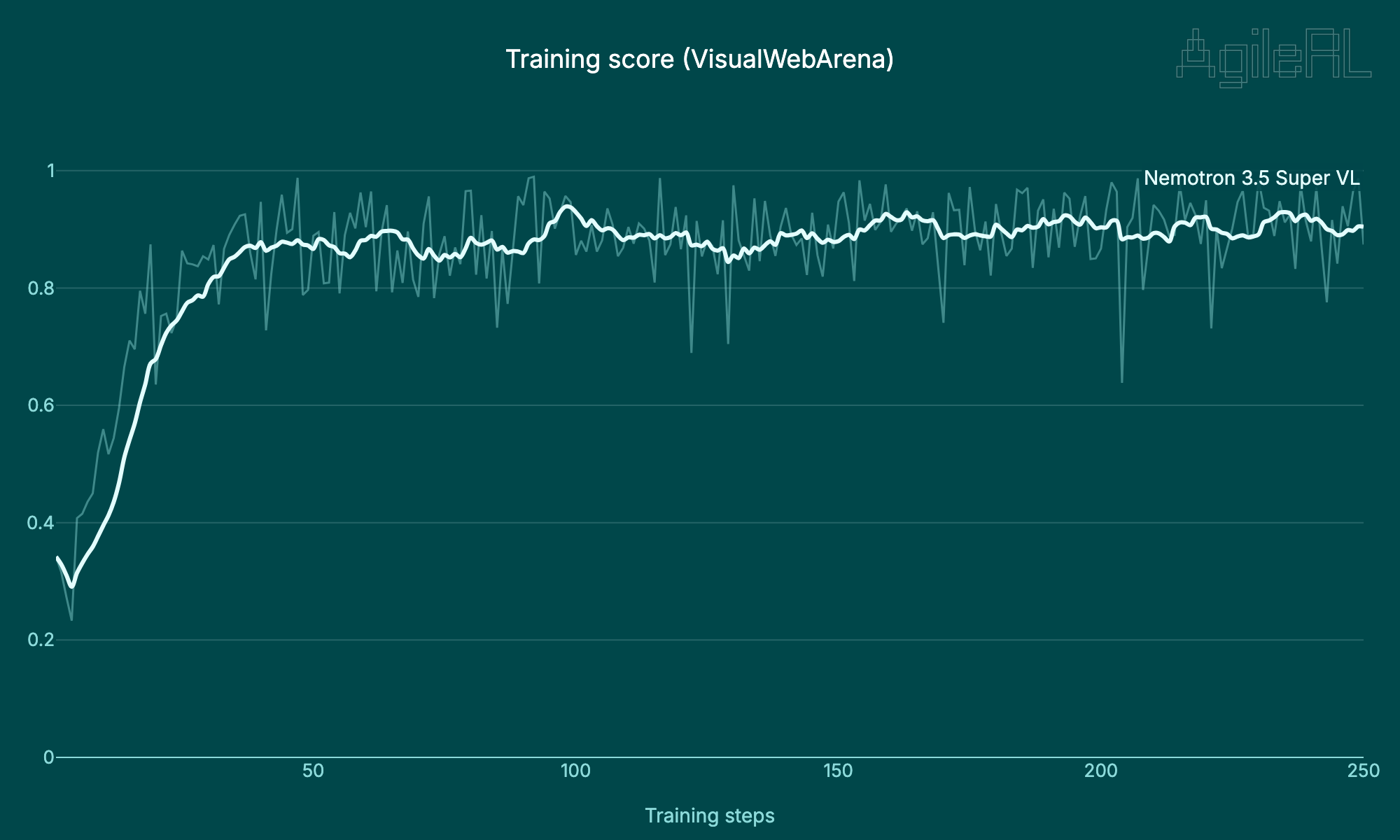
Over 250 steps, the training score rose from 0.30 to over 0.90 as the agent learned to solve the task. Each episode is a multi-step browser job, up to 15 turns. Many of the tasks only work if the agent reads a photograph and then clicks through several pages in the right order; one wrong click wastes token budget on the wrong page, and through trial and error the agent learns to solve tasks efficiently.
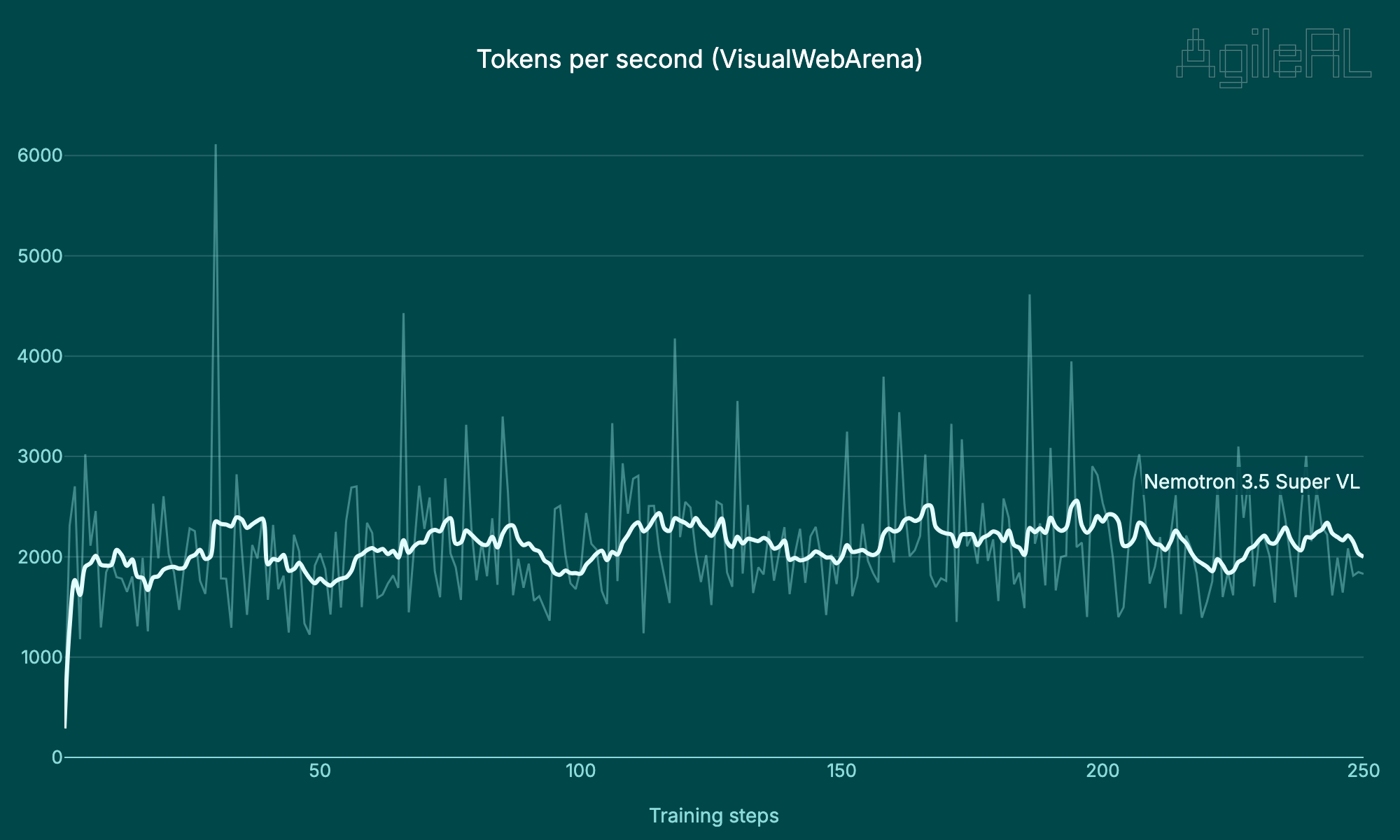
The cluster's throughput was 2400 tokens per second on average. Each step took 5.2 minutes, so 308 steps ran in 22 hours on 24 H100 80GB GPUs. A turn in this environment is about 5,000 tokens, including a ~900-token screenshot, and 384 browsers are in flight at once, but Arena handles this demanding multi-turn task with ease.
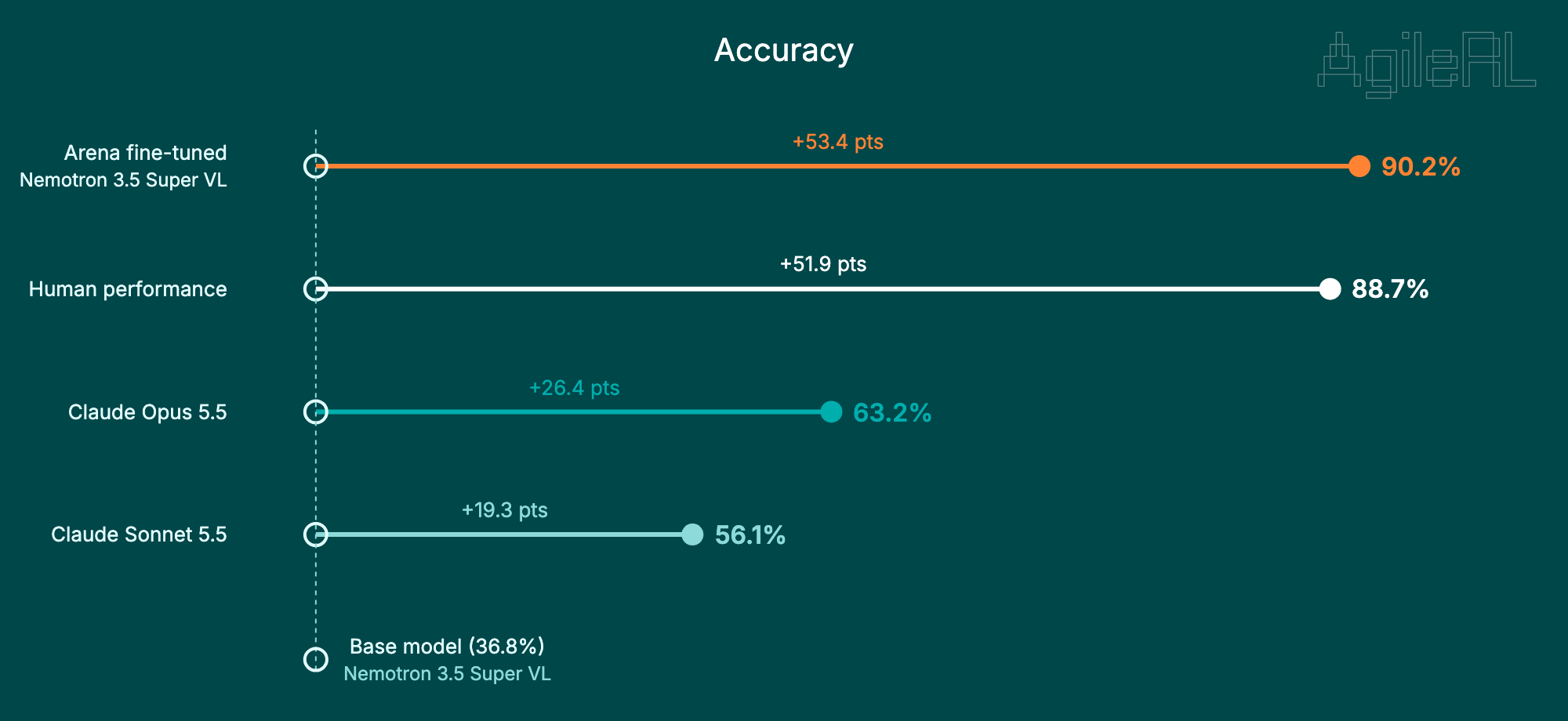
Base Nemotron 3.5 Super VL succeeds on 30.7% of the held-out tasks. NVIDIA released it as a general vision-language model, not as an agent for these websites. Claude Sonnet 5.5 and Opus 5.5, run under the same conditions, succeed on 56.1% and 63.2% respectively. After this Arena run, Nemotron 3.5 Super VL succeeded at 90.2%, above both Claude models and above the 88.7% human success rate reported for VisualWebArena. Surpassing the Claude models demonstrates how a fine-tuned model with 12B active parameters can be far more effective than a large, generalist one. Beating the human baseline demonstrates that Nemotron 3.5 Super VL can be used to automate this kind of computer-use work, and extends to other tasks too, including learning to use internal tools.
Here are two held-out episodes from the trained agent. In the first, the instruction is: "What is the email of the seller of the most expensive item in Photos + Videos that has an animal for its image?" In the second: "Navigate to the oldest listing in the Cell phones category which has a hot pink screen in the image."
Both examples show how the model has learned to navigate the web using the browser and handle complex, multi-step tasks.
Teams in banking, aerospace and government are moving off frontier APIs, and control is usually what starts that. Depending on a provider means trusting that the model stays available and that its behavior does not shift between releases. Where screenshots of internal tools are involved, data sovereignty also comes into question. Train and host the model yourself, and those screenshots never leave your network.
Per-token pricing also compounds faster than most teams budget for, which is why large enterprises already cap token spend. In this setup a screenshot is about 900 tokens, and a full turn, reasoning included, about 5,000. A task can take 15 of those turns. A model you host is a fixed cost on hardware you own, and it does not grow with the number of pages the agent opens.
Performance on your actual task matters more than general capability. Your checkout, your admin UI, the comment your team is supposed to leave: none of that appears in a foundation model's pretraining set, and a model that has not been trained on it will not infer it. A prompt can describe a convention, but training is what encodes and ensures that behavior in the agent's weights. Nemotron 3.5 Super VL's performance after fine-tuning with Arena is superior to Claude Opus 5.5. To gain the same boost on a new task, all that is needed is a different dataset or RL environment.
AgileRL is partnered with NVIDIA for post-training. Nemotron 3.5 Super VL is on Arena from today's release, as are the rest of the Nemotron models we already support. Bring a task: a dataset, or a description of what your agent has to get right. We will train and deploy an agent on it with you in a live session, on your infrastructure, with the weights yours to keep.